

Latest

Talk, ‘Liquidate AI Art’, Computer Arts Society, London, 15 October, 2025.

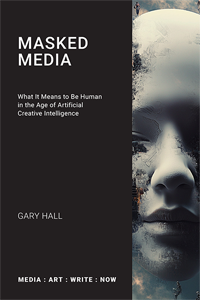
Masked Media: What It Means to Be Human in the Age of Artificial Creative Intelligence

(2025) Ecologies of Dissemination issue of PARSE Journal #21 - Summer, edited by Eva Weinmayr and Femke Snelting. (I am one of the contributors to this experimental issue which emphasizes collective, community-based and relational practices of knowledge production over individual authorship.) 

Robot Review of Books

Some recent and not-so-recent publications

A Brief History of Writing: From Human Meaning to Pattern Recognition and Beyond, with Joanna Zylinska

Experimental Publishing Compendium

Combinatorial Books: Gathering Flowers (book series)

How To Be A Pirate: An Interview with Alexandra Elbakyan and Gary Hall by Holger Briel’.

'Experimenting With Copyright Licences' (blogpost for the COPIM project - part of the documentation for the first book of the Combinatorial Books pilot)

Contribution to 'Archipiélago Crítico. ¡Formado está! ¡Naveguémoslo!' (invited talk: in Spanish translation with English subtitles)

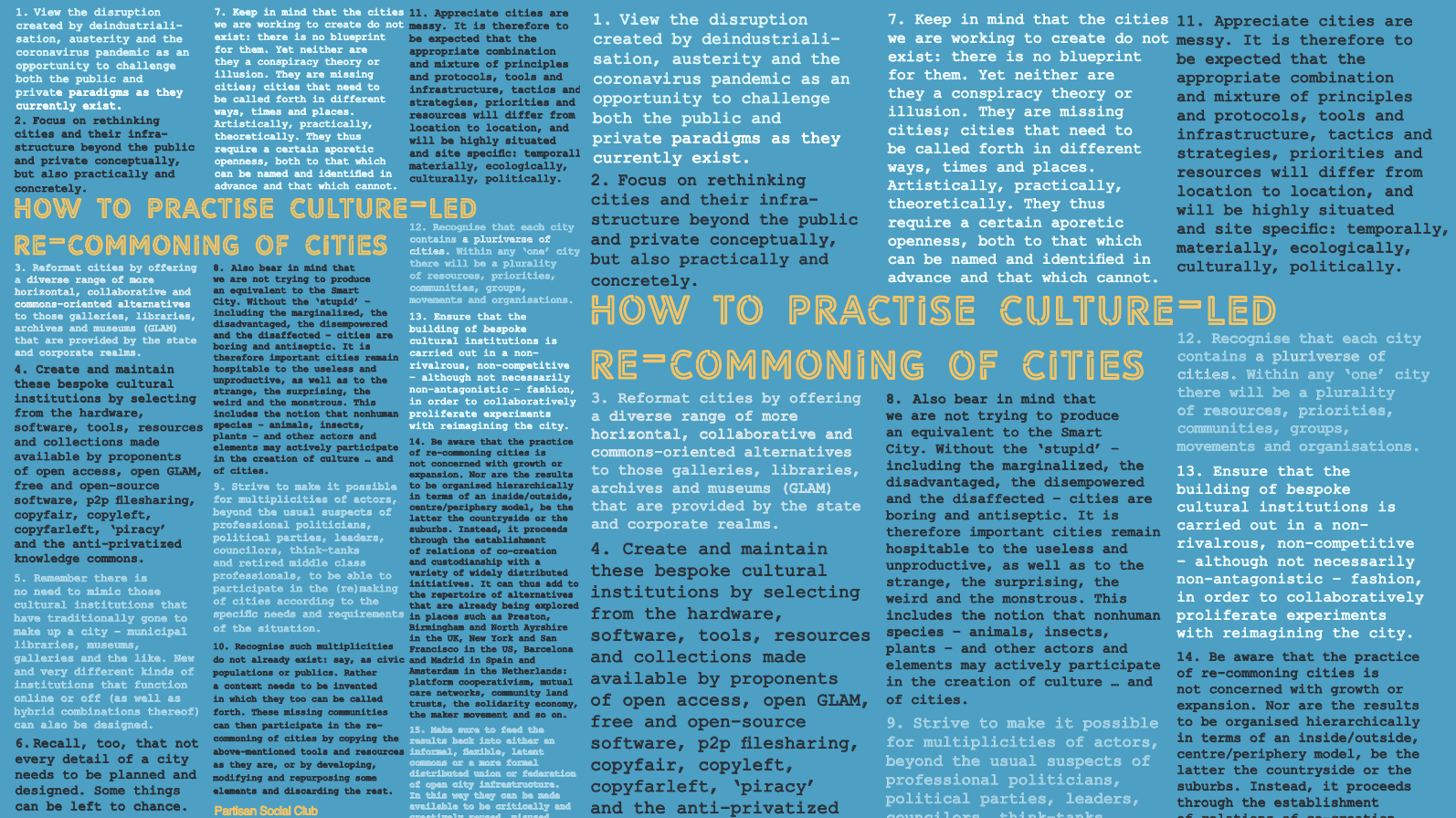
How to Practise the Culture-led Re-Commoning of Cities (printable poster), Partisan Social Club, adjusted by Gary Hall

'Writing Against Elitism with A Stubborn Fury' (podcast)

'The Uberfication of the University - with Gary Hall' (podcast)

'"La modernidad fue un "blip" en el sistema": sobre teorías y disrupciones con Gary Hall' ['"Modernity was a "blip" in the system": on theories and disruptions with Gary Hall']' (press interview in Colombia)

'Combinatorial Books - Gathering Flowers', with Janneke Adema and Gabriela Méndez Cota - Part 1; Part 2; Part 3 (blog post)

Open Access

Most of Gary's work is freely available to read and download either here in Media Gifts or in Coventry University's online repositories PURE here, or in Humanities Commons here

Radical Open Access

Radical Open Access Virtual Book Stand

'"Communists of Knowledge"? A case for the implementation of "radical open access" in the humanities and social sciences' (an MA dissertation about the ROAC by Ellie Masterman). 

Tuesday
Dec022025

The Independent Intellectual vs Posting Zero and the Dead Internet

Below is my short, ten minute introduction to SCREENSHOT BABEL, a workshop I ran with Ester Freider as part of The Cyberbaroque: A Neologism-Based Symposium. Organised by Everyone is a Girl (EIAG), and held at Anomalous in London on November 20, 2025, the symposium explored the idea of the cyberbaroque allegory through presentations, a reading, a workshop, and a film screening.

---

My name’s Gary Hall. I’m a media philosopher. In my current work I'm exploring whether we need a different way of doing internet theory and of being creative – something beyond both capitalist and liberal humanist logics. In other words, beyond the rules of the traditional university system and the newer influencer-driven creator economy, neither of which feels quite right. 

In academia, we still work within a hyper-competitive institutional culture stuck in McLuhan’s Gutenberg Galaxy: legacy theorists writing long-form books and articles about radical politics, collectivity and community yet being marketed – and marketing and promoting themselves – as individual intellectual ‘stars’. How appropriate is it to keep operating like this?  To what extent can we fully understand art, writing and media in the post-Gutenberg age while behaving as though we still live in that of Gutenberg? It's an inherited template for being an author and thinker – and for how they are produced – that feels increasingly outdated and unappealing to many.

So I understand why many of the ‘post-naïve generation’ of internet artists and theorists – people like Joshua Citarella of Doomscroll and Do Not Research (the latter being an influence on Everyone is a Girl) – want to by-pass the ‘liberal’ gatekeepers of the ‘old elite’ – galleries, museums, universities, academic presses, peer-reviewed journals. Instead, they’ve turned to YouTube, Substack, Instagram and podcasting, to present themselves as independent, self-organised writers and researchers. Yet this counter-elite model has problems of its own.

For one thing, operating outside the traditional institutional structures for any length of time as a more intellectual, leftist version of the content-creator-come-influencer requires privilege – not to mention brand name recognition and profile.  Too often, it’s white, middle-class, well-resourced, well-educated men who can afford – financially and socially – to function as a self-focused freelance business like this.The possibility of succeeding is therefore limited to a privileged few: it’s not a pathway that can be widely replicated. 

For another, this counter-elite model has also produced a wave of right-wing ‘edge lords’: cyberbaroque sophists such as Jordan Peterson, Naomi Wolf and Candice Owens who, as Ester puts it, use ‘clever but false arguments to trick you into believing them, or believing they are smart.

For still another, many alternative media communities want to create according to different principles from the mainstream - including a ‘post-individualist’ search for connectivity, cooperation, collaboration and community through mailing lists, message boards, Discord channels and indie presses. But the gravitational pull of the algorithms is strong. All too often, people slide back into – and may actively produce – the neoliberal subjectivity of the commodified cult of personality associated with the attention systems of late capitalist influencer culture – and they do so even as they’re mocking and critiquing and misusing this individualist subjectivity and trying to move beyond it. 

As Morgane Billuart observes, in this environment where one’s critical practice,  whether it concerns post-internet art, politics, activism, resource sharing or community building, is self-consciously conceived as a business model, ‘the use of self – one’s voice, face, and opinions – long rejected by traditional academic standards of rigor, has proven highly effective.’ Here the virtual intellectual knowingly – if reluctantly – becomes the product as a pragmatic means of sustaining their work. They just live the contradiction, because performative self-branding builds audiences and fosters parasocial connections and community engagement.

So, the question is: how much of an alternative is this counter-elite model really? Is sustaining your practice through social media, advertising revenue, micro-payments and subscription-based sites such as Substack and Patreon – turning your ‘authentic’ self – appearance, autobiography, personality, lifestyle – into a marketable, monetizable, attention-grabbing persona, just a means of financial survival in the face of institutional and state funding cuts for artists and academics? Is it the necessary price if you want to do interesting critical and creative work today and have others interact with it? Or is this means of fulfilment through self-production and promotion another form of control? Is this content creator too much of a cyberbaroque sophist and trickster?

Perhaps it’s more ambivalent than that. Perhaps – like the aesthetics of Everyone Is a Girl – it swings both ways. Perhaps, for reasons of tactics and strategy, it’s both at the same time.

But if both have their problems, maybe the issue shouldn’t be set up in terms of liberal thinker vs. neoliberal influencer, legacy theorist vs. libertarian or leftist disruptor, institutional academics vs independent, ‘hyperfeminine “i’m just a girl”’ meme’ makers, at all? Perhaps we need something else, a ‘third way’?

Are we in fact already seeing hints of such a third direction in those who treat a large Instagram following as a sign your work has become overly shaped by algorithms? Post-pandemic – after a period of everyone being being perpetually online – having thousands of followers is no longer particularly difficult or rare. With all the talk of a ‘dead internet’ – where content is increasingly AI-generated and followers may be bots – it might even be a warning sign. Having fewer than 500 followers, by contrast, can suggest that – if you’re posting at all, rather than ‘posting zero’ – you’re posting about what genuinely interests you, not what the internet wants you to find interesting.  

So what might a critical and creative practice look like if it didn’t rely on either:

• the prestige economy of the old institutions, or

• the algorithmic hustle of the platform economy and its influencers and content creators, with their aim, as Ester says – however critical, playful and experimental they may be – of ‘taking up as much time and space in [your scrolling] brain as possible’?

Can we imagine a space where theory and creativity aren’t shaped by the need to either impress a university press or brand ourselves into exhaustion? Is it this kind of space we’re creating and exploring this evening?
 

Monday
Oct202025

The Commons vs Creative Commons Conclusion: Commoner Is Not An Identity

This is the final part of an initial 5,000 word draft of a specially commissioned piece on the commons and Creative Commons. It’s for an open-access online glossary on the contemporary condition and near future that's being produced by the Chinese Academy of Art.

Contents:

I: Introduction * Conceptual Overview * Elinor Ostrom and the Tragedy of the Commons * Liberal Commons * Radical Left Commons * From Capitalism to Postcapitalism – and Back Again

II: The Undercommons * Latent Commons * Uncommons * The Unknown Common * Common Misunderstanding No.1: The Commons is Not Inherently Left-wing

III: Creative Commons * CC and AI * Common Misunderstanding No.2: Creative Commons is Not a Commons * The Commons and Creative Commons: Some Distinctions * Alternatives to Creative Commons

IV: Conclusion: Common Misunderstanding No.3: Commoner is Not an Identity * Common Misunderstanding No.4: There is Not One Commons

---

Conclusion 

Two further common misunderstandings about the commons are worth mentioning.

Common Misunderstanding No.3: Commoner is Not an Identity

The Commons, for some, is actually a noun not a verb. The emphasis here is less on understanding the commons in terms of shared assets – or even as a particular kind of community, style of collective life, place or space – and more on conceiving the commons as a practice. This is why they prefer to think in terms of commoning rather than commons: to highlight its processual and performative nature. It is an approach evident in many accounts of the radical commons and the emphasis placed there on commoning: the ongoing generative social practices through which both the commons and the community of commoners are invented, constituted and sustained. Balser and de la Cadena’s description of the uncommons as “a commons that would be a continuous achievement” – not a fixed goal or final endpoint but a permanent becoming – also deserves to be highlighted in this context (2018, 19).

So, too, does the process-oriented account of the commons provided by Stavros Stavrides. When community formation is directed toward generating shared space and purpose – the common – it must be understood as open-ended and constantly evolving, Stavrides insists. This is because the commons does not exist as a stable, pre-existing reality to be seized and held on to. Nor are commoners defined by fixed identities that exist prior to their taking part in the living process that is commoning. On the contrary, both emerge through – and are only born in – the act of commoning. This orientation carries important implications. For one thing, it displaces the idea that community membership depends on a shared, pre-given identity held in common. Instead, the identities of the commoners are formed in and through the practices of sharing and participation in the commons. For another, belonging is understood as a matter of action rather than origin. Those who take part in commoning become members of a community that itself comes into existence through those very acts (Stavrides 2022, 26–27).

Common Misunderstanding No.4: There is Not One Commons

Although many people refer to “the commons” as if its meaning were self-evident, without need of further clarification or explanation, there is no single, universally-agreed upon idea of the commons. Nor is there a one-size-fits-all model for how commons are organised or function. “Every instance of collaboration makes room for some and leaves out others,” Tsing says of the latent commons (255). Meanwhile, David Harvey notes how “good solutions at one scale (the ‘local,’ say) do not necessarily … make for good solutions at another scale (the global, for example).” As a result, issues concerning the commons are “contradictory and therefore always contested” (2012, 69-71). Even among advocates there is no shared understanding of the commons. Ironically, this is not something they have in common.

Moreover, commons themselves are not inherently harmonious or homogeneous. For all their mutual bonds, participants in a commons can differ in important ways. The relationships that connect them may be shaped as much by division and divergence as by solidarity and collective interest. These relationships, too, may be something commoners do not have in common.

Along with the difficulty of managing a participatory and non-hierarchical commons across a variety of scales, not just the small and local, this ultimate lack of cohesion and shared purpose may explain why a commons-based movement or collective political subject large enough to meaningfully challenge, let alone replace, capitalism and its methods of organising resources and labour has yet to emerge. At the same time, this may be just what the commons and commoning is. Rather than being a single, self-identical concept, “the commons” is better understood as a dynamic site where a rich diversity of individuals, groups, communities, movements, organizations, initiatives and practices – each with distinct needs and interests regarding the use, management, reproduction, exchange and distribution of natural and cultural resources – intersect, but remain in tension.

Monday
Oct202025

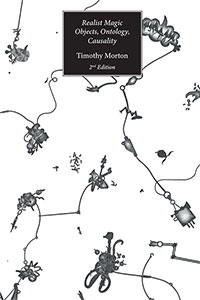
Realist Magic: Objects, Ontology, Causality (2nd edition, with a new Preface) by Timothy Morton: New Open Access Book

Open Humanities Press is pleased to announce the publication of Realist Magic: Objects, Ontology, Causality (2nd edition, with a new Preface) by Timothy Morton.

Like all Open Humanities Press books, Realist Magic is available open access (= it can be downloaded for free): 

https://www.openhumanitiespress.org/books/titles/realist-magic-2nd-ed/

Book description

Object-oriented ontology offers a startlingly fresh way to think about causality that takes into account developments in physics since 1900. Causality, argues Object Oriented Ontology (OOO), is aesthetic. In this book, Timothy Morton explores what it means to say that a thing has come into being, that it is persisting, and that it has ended. Drawing from examples in physics, biology, ecology, art, literature and music, Morton demonstrates the counterintuitive yet elegant explanatory power of OOO for thinking causality. 

With a new Preface by Timothy Morton.

Author Bio

Morton is the author of the libretto Time, Time, Time (opera by Jennifer Walshe, 2019), and of numerous artworks including We Are the Asteroid (with Justin Guariglia, 2019); Come Fast from the Dark (with Andrew Melchior, 2024); and This Huge Sunlit Abyss From The Future Right There Next To You (with Björk, 2015). In 2018 Morton co-wrote and appeared with Jeff Bridges in Living in the Future’s Past, directed by Susan Kucera. Morton is Rita Shea Guffey Chair of English at Rice University.

Morton has written Hell: in Search of a Christian Ecology (Columbia, 2024); All Art Is Ecological (Penguin, 2021); Spacecraft (Bloomsbury, 2021); Being Ecological (Penguin, 2018); Humankind: Solidarity with Nonhuman People (Verso, 2017); Dark Ecology: For a Logic of Future Coexistence (Columbia, 2016); Nothing: Three Inquiries in Buddhism (Chicago, 2015); Hyperobjects: Philosophy and Ecology after the End of the World (Minnesota, 2013); Realist Magic: Objects, Ontology, Causality (Open Humanities Press, 2013); The Ecological Thought (Harvard, 2010); Ecology without Nature (Harvard, 2007); 8 other books and 300+ essays on philosophy, ecology, literature, music, art, architecture, design and food. 
 
Series

The book is published as part of the New Metaphysics series: https://www.openhumanitiespress.org/books/series/new-metaphysics/

Series Design

The New Metaphysics series design is by Katherine Gillieson with cover illustrations by Tammy Lu.

Monday
Sep222025

'Liquidate AI Art': 15 October Talk for Computer Arts Society

Liquidate AI Art 

Speaker: Gary Hall; Moderator: Sean Clark 18:00 BST, Wednesday, 15 October 2025 Other time zones here: https://www.timeanddate.com

This event is via Zoom only.  It is open to the public and  free but you need to book your place here: https://ComputerArtsSociety151025.eventbrite.co.uk

This talk expands on my recent book Masked Media: What It Means to be Human in the Age of Artificial Creative Intelligence. It argues for liquidating AI art, not out of a dismissal of artificial intelligence as techno-fascist (McQuillan), nihilist (Golumbia), parrot-like (Bender et al) synthetic shit (Crawford), but an insistence that art has always been created by assemblages of humans and nonhumans. There is no pure, authentic human creativity to distinguish from works generated with technologies like Stable Diffusion.  

The talk references the International Coalition for the Liquidation of Art – whose members included Gustav Metzger, first editor of the CAS bulletin PAGE – and especially Frieder Nake’s assertion in PAGE 18 that ‘there should be no computer art’. For Nake, art should not be divided into commodifiable styles based on the tools used, but should instead function as a radical force capable of disrupting the hierarchies of the bourgeois art world.  

Picking up on this challenge, ‘Liquidate AI Art’ shows how UK arts funding today overwhelmingly benefits upper- and middle-class, privately educated Oxbridge graduates. Efforts to promote inclusion through social mobility risk reinforcing this unjust system. What’s needed is a redistribution of resources – e.g. through the liquidation of the UK’s copyright regime – to support radically different artistic practices beyond the white, male, middle-class, liberal humanist norm. 

The event will be recorded and uploaded to the CAS YouTube Channel.

___________________________________

The next CAS meeting will feature a talk by Anika Meier on Wednesday, 19 November 2025, via Zoom.
You can see our future programme here: https://computer-arts-society.com/events/index.html

Monday
Sep012025

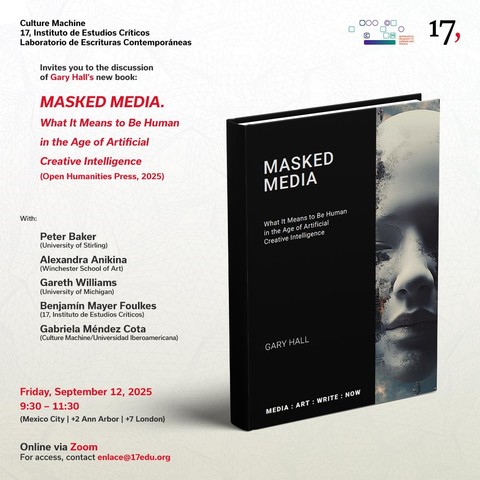
Online event on Masked Media: 12 September, 2015

Poster featuring a copy of a book. The cover is mainly in black with lettering in white. The lettering on the post is black and red on a white background.

Above are details of an upcoming online 12 September event on my new book Masked Media: What It Means to be Human in the Age of Artificial Creative Intelligence (London: Open Humanities Press, 2025):

Co-organised by Culture Machine and 17, Instituto de Estudios Críticos in Mexico city, the event is hosted by the Laboratory of Contemporary Writings / Laboratorio de Escrituras Contemporáneas, which is being launching with this discussion of Masked Media.

The idea for the Laboratory of Contemporary Writings emerged from a recent ACLA Seminar titled ‘Displacing Academic Practices in the Ruins of the Neoliberal University’. While linked to conversations around infrapolitics (e.g., culturemachine.net/vol-22-anth), its focus is broader: on writing, subjectivity, students, ourselves, and how to respond to the conditions we’re living through today.

To join this event online, email: enlace@17edu.org

---

On Masked Media: What It Means to be Human in the Age of Artificial Creative Intelligence

If we want a more socially and environmentally just future, do we need a radical new theory of change – or to radically change theory? 

It’s this question that Gary Hall and his collaborators have been addressing for over twenty years with experimental publishing projects such as Open Humanities Press, Liquid and Living Books, Radical Open Access Collective, and the Culture-led Re-Commoning of Cities. Unsettling received ideas of the author and book, originality and copyright, real and artificial intelligence, these uncommon communities of theorist-mediums have been testing some of the ‘non-modernist-liberal’ modes of creating and sharing knowledge that are enabled by various media technologies, from writing and print through photography and video to computers and GenAI. By thinking outside the masked black box that renders the anthropocentric, Euro-Western knowledge-making practices of the arts and humanities invisible – ensuring the human is kept ontologically separate from the nonhuman, be it animals, the planet or algorithmic machines – they show there’s no such thing as the human, the nonhuman already being in(the)human. 

Masked Media is one such experimental project. It is not a 'human-authored' work. Instead, the thinking within it has been generated by a radically relational inhuman assemblage that includes AI and more. Although the book appears under a real name –  ‘Gary Hall’ – which, like Banksy and Karen Eliot, acts as a mask, it is not the intellectual property of a singular human individual, and is published under a Collective Conditions for Re-Use licence to reflect this. Masked Media demonstrates how such norm-critical experimentation is of vital importance to our understanding of everything from identity politics and the decolonialisation of knowledge, through epistemologies of the Global South and the possibilities of open city infrastructure, to extractive capitalism, planetary destruction and the Anthropocene.